Dynamic data and request chaining
Variables allow you to dynamically insert data into a request using built-in functions (timestamps, random strings, hashes), configuration data from environments and data extracted from a previous response in a test run. Data is inserted into requests using a simple template format.
- Using variables to pass data between steps (chained requests)
- Environment variables
- Use built-in variables and functions
- Use variables in requests
- Evaluation order of initial variables
Use variables to pass data between steps (chained requests)
Request steps can define variables that extract data from HTTP responses returned when running the test.
To create a variable, follow these steps:
- Expand a request within your test.
- Click Variables.
- Specify the location of the data you want to extract from the response.
- Choose a variable name to reference it in a subsequent request.
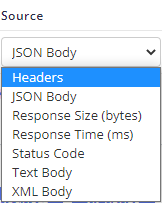
Source
The location of the data to extract. Data can be extracted from HTTP header values, JSON body, response size or time, response status code, text body, or XML body.
Property
The property of the source data to retrieve. For HTTP headers this is the name of the header. For XML and JSON content, see below. This field is unused for Text Body and Status Code.
Variable name
The name of the variable to assign the extracted value to. In subsequent requests you can retrieve the value of the variable by this name. See Using variables in requests.
You can extract data through the following methods:
- Extract data from JSON Body Content
Data from a JSON response body can be extracted by specifying the path of the target data using standard JavaScript notation. View sample JSON expressions for data extraction. - Extract data from XML Body Content
Data from an XML response body can be extracted by specifying the path of the target data using XPath. In the 'Property' box of a variable definition that uses 'XML Body' as the source, enter an XPath expression to locate the data to extract and assign to the variable. - Extract data from Text Body
Saves the entire text of the response to a variable. - Extract data from Text Body using Post-response Scripts
You can specify the start and end boundaries of data to be extracted by running an extractor script through Post-response scripts.
Local and global variables
API Monitoring supports two types of variables used throughout a test: local variables and global variables.
-
Local variables are defined within the scope of a single test. They include variables extracted from previous responses, variables created through scripts, and initial variables defined in the selected environment. Environments allow you to manage this variable configuration on a per‑test or per‑bucket level. Common values—such as base URLs, API tokens, or other shared configuration—should be stored as Initial Variables or defined in an Initial Script. Once defined, these values are available to all requests within that test.
-
Global variables streamline test creation by making shared values available on a team level, without requiring every test to redefine them locally. The values are managed through Team Settings and are made available directly in the Test Editor. Global variables appear as a dedicated category in the variable panel and can be used anywhere a variable can be referenced—such as URLs, headers, parameters, and request bodies.
Notes:
-
Global variables are like default values for the whole team. Any variable defined at the environment level or below with the same name will override the global variable. They're meant to provide team-wide defaults (like a common base URL or API key) that individual tests can override when needed.
-
When global variables are present, they are automatically merged with local variables for convenience in the editor.
-
If a local variable and a global variable share the same name, the local variable always takes priority. In this case, the global variable remains visible in the editor but is marked as disabled to indicate that it is shadowed by the local value.
-
Global variables also appear in the editor's auto-suggest feature, listed after Local Variables and before Test Data.
Initial variables (local variables)
Initial Variables specify data available to all requests in a test, including the first request. This can be useful for storing values that are common to all requests (like API keys) or other data required to set up the test run. Each test run will use the initial variables specified by the selected environment. To override variables on a per-run basis, use a Trigger URL with custom initial variables.
Initial script (local variables)
Initial Scripts are executed before the first request in a test is made, but after the Initial Variables have been evaluated. variables.get() and variables.set() can be used to read and write variable values to be used by requests in the test. See: Scripts: Initial script and Evaluation order of initial variables.
Use built-in variables and functions
In addition to the variables you define yourself, you can use these built-in variables and functions to generate common types of data.
| Variable/Function | Description | Example output |
{{timestamp}}
|
Integer Unix timestamp (seconds elapsed since January 1, 1970 00:00 UTC) | 1384035195 |
{{utc_datetime}}
|
UTC datetime string in ISO 8601 format. | 2013-11-07T19:24:41.418968 |
{{format_timestamp(value, format)}}
|
Timestamp of the specified value in the specifiedformat. Any delimiters (e.g. -, /, ., *, etc.) canbe used in the format with a combinationof any of the following date/time format options. Also accepts variables. E.g. {{format_timestamp({{timestamp}}, YYYY-MM-DD)}}
|
2013-31-03 |
{{timestamp_offset(value)}}
|
Integer Unix timestamp offset by the specified value in seconds (going back in time would be a negative offset value). Values should be passed without surrounding quotes. |
1383948795 |
{{random_int}}
|
Random integer between 0 and 18446744073709551615. | 407370955 |
{{random_int(a,b)}}
|
Random integer value between a and b, inclusive. |
44674407370 |
{{random_string(length)}}
|
Random alphanumeric string of the specified length (max 1000 characters). |
ddo1qlQR81 |
{{uuid}}
|
Random universally unique identifier (UUID). | 99386c08-6da7-4833-bb31-e70ce747c921 |
{{encode_base64(value)}}
|
Encodes value in Base64. Values should be passed without surrounding quotes. Also accepts variables e.g. {{encode_base64({{username}}:{{password}})}} |
dTpwDQo= |
{{md5(value)}}
|
Generate an MD5 hash based on value. Values should be passed without surrounding quotes. Also accepts variables e.g. {{md5({{timestamp}})}} |
50b7fe4da64720232c25bc7c6d66f6c5 |
{{sha1(value)}}
|
Generate an SHA-1 hash based on value. Values should be passed without surrounding quotes. Also accepts variables e.g. {{sha1({{timestamp}})}} |
e0bd9304537cd8cb4e69ef5d73771fe218c484f5 |
{{sha256(value)}}
|
Generate an SHA-256 hash based on value. Values should be passed without surrounding quotes. Also accepts variables e.g. {{sha1({{timestamp}})}} |
e3376ffb4b1e2c04b0fe68b52e8654696814b4883b47a56ff5a7df883725d8c1 |
{{hmac_sha1(value,key)}}
|
Generate an HMAC using the SHA-1 hashing algorithm based on value and key. Values should be passed without surrounding quotes. Also accepts variables e.g. {{hmac_sha1({{timestamp}},key)}} |
163a04cd86a82b948a7e85f0ed3cd3b5929a7d0c |
{{hmac_sha256(value,key)}}
|
Generate an HMAC using the SHA-256 hashing algorithm based on value and key. Values should be passed without surrounding quotes. Also accepts variables e.g. {{hmac_sha1({{timestamp}},key)}} |
eb0b5c5b2a04ac25ff52c886e115f2e60c0dd8d50bab076dc065e95f5fd37fb9 |
{{url_encode(value)}}
|
Create a percent-encoded string suitable for URL querystrings. This is not required for URL or form parameters defined in the request editor which are automatically encoded. Only use this if you need to double encode a value in a URL or include a URL encoded string in a header value. | This%20is%20100%25%20URL%20encoded. |
{{runscope_environment}}
|
The name of the environment used for this test run. | prod |
{{runscope_environment_uuid}}
|
The unique ID of the environment used for this test run. | ab34b187-bcde-4f41-9ec1-ff77e99aa2d6 |
{{runscope_bucket}}
|
The bucket key for the API Monitoring Bucket the executing test is contained within. | y0z5xkr1oa3m |
{{runscope_bucket_name}}
|
The name of the API Monitoring Bucket the executing test is contained within. | Jumping Rabbit |
{{runscope_test_uuid}}
|
The unique identifier for the API Monitoring test. | a8ea3ddd-73bb-435c-bc44-7c4bc8d99647 |
{{runscope_test_name}}
|
The name of the API Monitoring test. | Sample Test |
{{runscope_region}}
|
The region code indicating the location in which this test run was initiated. | eu1 |
{{runscope_agent}}
|
The unique identifier for the agent which is running the agent. Blank if run from a API Monitoring location. | 83a24630-323d-501a-74a1-a7e51485ca12 |
Request an additional built-in variable or function by contacting support.
When using a built-in variable in the value of an initial variable, the value will be generated once and remain constant across all the requests in a test (unless later overridden by another variable definition).
Override built-in variables
You can define a variable that uses the same name as a built-in variable or function. This will override the built-in value with the value extracted from the test response.
In the case of a local and a global variable sharing the same name, the local variable always takes priority. In this case, the global variable remains visible in the editor but is marked as disabled.
Use variables in requests
Once a variable has been defined, you can use it in any subsequent request. The test steps editor will display the 'Available Variables' that have been defined prior to the selected request. Variables can be used in any request data field including the method, URL, header values, parameter values and request bodies.
To include the value of a variable in a request, enter the name of the variable surrounded by double braces e.g. {{variable_name}}.
If a variable is undefined when a request using that variable is executed, the test will fail.
Evaluation order of initial variables
Variables can be set at various points in the setup of a test run. At each step of the setup, a variable value specified in an earlier step can be overridden. Global variables are loaded first into the context, then local environment variables (from shared and individual environments) are applied on top, overriding any global variable with the same name/
The evaluation order, from lowest to highest, is:
-
Global Variables (team-wide, set on the Global Variables page)
-
Variables defined in a shared environment
-
Variables defined in an individual test environment
-
Variables set via an environment-specific or a bucket-wide Trigger URL
-
Variables set using variables.set() in a shared environment's Initial Script
-
Variables set using variables.set() in an individual test environment's Initial Script